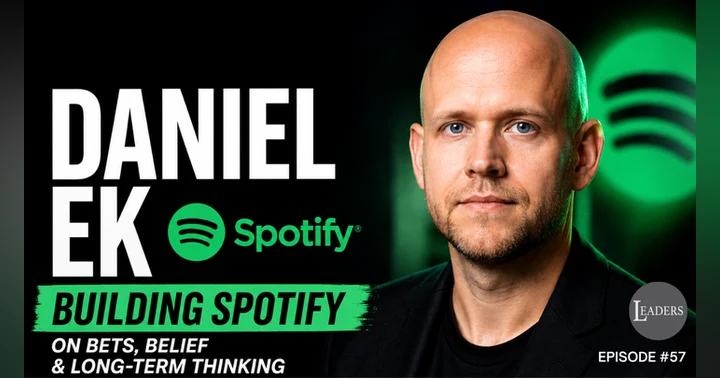
Daniel Ek

 Spotify
 Apple Podcasts
 YouTube
 Castro
 RSS Feed
 Episode 57: What does it take to reinvent an entire industry? In this episode, we explore the leadership journey of Daniel Ek, the entrepreneur who transformed music streaming by co-founding Spotify. From challenging entrenched business models to building one of the world's most influential technology platforms, Ek's story is a masterclass in long-term thinking, relentless innovation, and resilient leadership.
We examine how Ek balanced bold vision with disciplined execution, navigated resistance from the music industry, cultivated a culture of experimentation, and scaled Spotify from a startup into a global company serving hundreds of millions of users. Along the way, we uncover the leadership principles that helped him attract world-class talent, embrace calculated risk, and continually reinvent the business as consumer behavior evolved. Spotify has since evolved its leadership structure, with Ek moving into the Executive Chairman role while continuing to guide the company's long-term strategy.
Whether you're an entrepreneur, executive, or aspiring leader, this episode offers practical insights on leading through disruption, making high-conviction decisions, building products customers love, and creating organizations capable of thriving in rapidly changing markets.
In this episode you'll learn:
- How Daniel Ek identified an opportunity to transform the music industry
- Why long-term thinking creates sustainable competitive advantages
- The importance of speed, experimentation, and continuous innovation
- How great leaders attract and empower exceptional talent
- Lessons in resilience when facing skepticism and setbacks
- What leaders can learn from Spotify's culture of product development and customer obsession
Follow Leaders:
Email us: theleaderspod@gmail.com
Picture a 20-some founder in Stockholm, flushed with cash from his first company. The sports car, the nightclubs, champagne sprayed around a room like it means something. He's living the version of success everyone tells you to want. And he hates it. Years later, Daniel Ek would describe that period in one word, empty. Not humbled by it, not nostalgic for it, empty. So, he did something almost nobody in his position does. He didn't tone it down. He walked away from the entire operating system of what a quote unquote successful founder was supposed to look like.
Now, fast forward. Ek runs one of the most culturally influential companies on Earth. The platform hundreds of millions of people open every day to feel something. And the man running it has built his whole life around refusing excess in any form. Three or four meetings a day, that's the ceiling. No more. Every morning, rain or snow, he goes for a walk because that's where the real thinking happens. Not in a boardroom. He doesn't do social calls. He said so flatly. Personally reserved, professionally ruthless. A guy who tried on the loud version of success, found it made him feel like nothing and built the quiet version instead. That reversal, the friction between who Ek used to perform and who he actually became is the thread we will pull on for today's episode of Leaders.
Episode 57 is Daniel Ek, the founder of Spotify. And as we allude to here, Daniel Ek is not your typical CEO. He's personally reserved but professionally ruthless. He goes on those long walks to sharpen his thinking. He looks to Beyonce for ideas on creativity. He refuses more than three meetings a day.
Daniel Ek has explicitly tied his thinking to not being embedded into the Silicon Valley ecosystem. He wasn't necessarily absorbing strategy by osmosis from the Google and Facebook style cultures that exist in Silicon Valley. Instead, he says he and other non-Valley founders had to work out first principles for themselves rather than copying the standard playbook. The mental model he borrows from is Elon Musk's semantic tree framing: the idea that you need to nail the fundamental principles, the trunk and the big branches of the tree, before getting lost in the details, the leaves, because without that foundation the details have nothing to hang on to.
When Spotify moved into podcasting, Ek's reasoning wasn't "podcasts are a different format so build a dedicated product." Instead, he broke the problem down to what job was actually being done for users: discovery, ubiquity across devices, search. Those were shared infrastructure Spotify already had. That let Spotify fold podcasts into the existing app rather than launching something entirely new, leveraging their existing 200 million plus user base instead of building podcast-specific distribution from scratch.
He's applied the same "strip it down to fundamentals" logic to company building itself, prioritizing user growth over near-term profitability early on, on the theory that a large engaged audience could be monetized later, framing Spotify's evolution in decades rather than quarters. As Spotify scaled, he talked about having to rethink his own management approach from the ground up: "the leadership approach that got you here won't get you there."
Creative inspirations: Leonardo da Vinci and Pablo Picasso. Da Vinci as the ultimate cross-disciplinary thinker, fusing art with anatomy and engineering — mapping onto Ek's instinct to treat music, podcasts, and video as shared infrastructure rather than siloed products. Picasso's arc of restless reinvention, moving from the blue period through cubism to surrealism, mirrors a company that pivoted from pure music streaming to podcasts, audiobooks, and now an AI-driven audio platform.
Ek believes the rate of learning is the best determinant of success: "I'm not an inventor. I just want to make things better." On creativity: "Creativity requires structure, not freedom. Most people get that backwards... Most creative people I know are almost scripted in their approach and process." On failure: "You can't have a culture of experimentation if you don't allow failures to happen."
His leadership style leans on an inverted-pyramid mental model, borrowed from a Scandinavian Airlines CEO story: the leader is at the bottom, enabling everyone above him. Most leaders think of themselves at the top of a pyramid and default to top-down. Ek inverts that.
On scaling meetings: "There's some leaders who prefer to have all executive decisions travel through them, but then you have to wait until the leader has availability to review all those things — it's creating this natural bottleneck. I typically don't have more than three or four meetings per day." He devotes most of his time to the long term, and treats coaching others on how to use their limited time as a core leadership function. Example: he pushed a director who hadn't taken a vacation in six months to take two weeks off to recharge.
He's studied other leaders closely: Mark Zuckerberg (stole the Friday Q&A format from him), Reed Hastings of Netflix (learned about pushing decisions down the organization and meeting the executive team only about once a month), Tobi Lütke of Shopify and Mike Cannon-Brookes of Atlassian — noting that none of them built their companies inside the traditional Silicon Valley environment, forcing all of them into first-principles company building.
Structurally, Spotify became known for the "squad" model — small autonomous cross-functional teams of six to ten people owning a slice of the customer journey, grouped into "tribes" kept under roughly 100 people, with "chapters" and "guilds" as connective tissue across disciplines and interests. The philosophy underneath it comes from Swedish management norms: flat hierarchy and coaching over command, consensus before commitment, "lagom" (the just-right amount — steady growth, carefully weighed decisions rather than rushed ones), and "jantelagen," a cultural discomfort with visible status or overt hierarchy.
The squad model was never as clean in practice as the white paper made it look — a former Spotify PM was warned before starting that it was more aspirational than reality, and the company tripled to 3,000 people in 18 months, showing cracks in the model at scale. Even Henrik Kniberg, the person most associated with the model, said it was never meant to be copied, just an example of how one company works.
Most recently, Ek has transitioned out of the CEO role into a co-CEO structure: Alex Norström owns business and content, Gustav Söderström owns product and technology, and Ek synchronizes across the company as Executive Chairman, effective January 2026. He's described his own career as roughly nine different "missions" under the same job title — starting with literally assembling furniture and negotiating the company's first deals, then running finance, then product, then sales and marketing.
He explained the move to Reuters: "I will be more involved than a typical US chairman... think of it more a little bit like moving from a player to coach." He views his most important function now as being a generalist, an editor of the vision, setting constraints and pulling the organization back to its purpose: "The value of a company is the sum of the problems you solve."
He frames Spotify's strategy as a "star" rather than a "constellation" — one centralized dominant hub, with users' listening context (not content format) determining what lives inside it, rather than separate apps for separate content types the way Meta runs Instagram, WhatsApp, and Messenger as distinct products. He describes Spotify's growth as many different linear S-curves stacked on top of each other — music, then podcasts, then audiobooks, now video — layered onto one unified star rather than separate hero products competing for attention.
On legacy: he wants to be known for trust, consistency, and the long game. Trust built through consistency over time — say what you'll do, then do it. De-risking deals for the record industry was short-term pain for long-term gain. Fighting complacency in a large company means continuing to raise the bar and do the right thing.
Closing line: Daniel Ek is a case study in self-aware leadership — knowing what you're not as much as what you are. A very reserved Swede who built one of the loudest companies in the world, arguably by getting out of the way and doing things his own way.