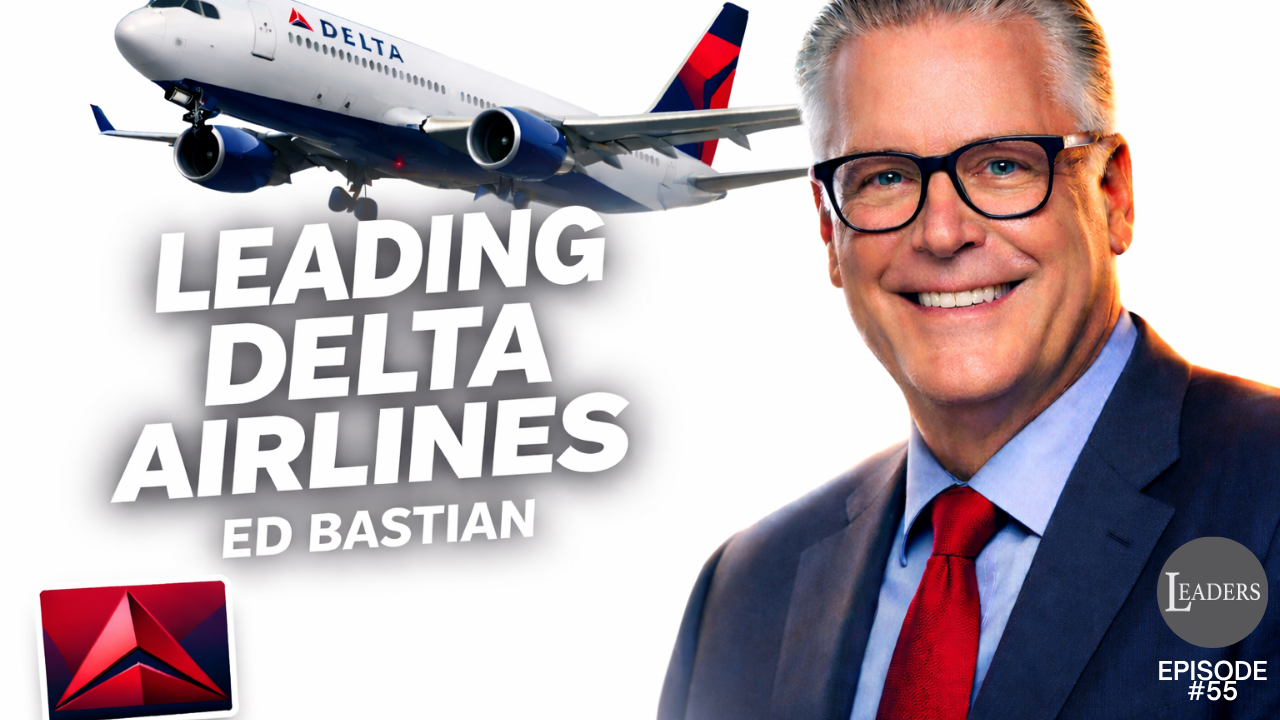
Boring Excellence: 5 Leadership Lessons From Delta CEO Ed Bastian

93%.
That's how far the number of passengers boarding Delta's planes fell in the spring of 2020, compared with a year earlier. Revenue for the quarter dropped 88%. At one point in March, the airline was burning through nearly $100 million in cash a day.
Most CEOs facing numbers like that reach for the obvious lever: mass layoffs.
Ed Bastian didn't. Instead, he told his employees exactly how bad things were, asked for volunteers to take unpaid leave or early retirement, and kept talking to them, constantly, until the crisis passed. About 17,000 people took a buyout or early retirement that summer. Delta came out the other side with its culture intact, and with its reputation for reliability intact.
I covered Ed on episode 55 of Leaders, and I came away convinced of something a little unfashionable. The best leaders aren't always the loudest ones. Sometimes they're the most consistent.
Here's how he does it, and what you can steal for your own team.
An unlikely airline CEO
Ed Bastian is not a pilot. He's not a showman. He's a finance guy.
Before Delta, he built his career in Big Four accounting, where he earned a reputation for discipline and clear thinking. He joined Delta in the late 1990s, just in time for the roughest stretch in modern airline history: 9/11, bankruptcies, and a fuel-price crisis.
He didn't rise on big ideas. He rose because he made things work, whatever the situation.
The mentor behind the method
A lot of Ed's approach traces back to Frank Blake, the former CEO of Home Depot. Blake took over Home Depot after a rough period, rebuilt trust with employees, and did it without ever being the loudest person in the room.
Ed took several lessons from him. Three stand out, and they work as a summary of everything that follows:
- Transparency beats spin.
- Consistency beats intensity.
- Humility scales better than ego.
Blake also refused to treat culture and execution as separate things. Soft skills and hard results, in his view, feed each other. Ed built Delta on exactly that idea.
Trait 1: Consistency over charisma
Ed shows up the same way in good times and bad. That's the whole point.
Listen to his earnings calls and you'll notice the tone barely changes from a record quarter to a rough one. No hype. No victory laps. No panic language. The meeting rhythm, the check-ins and the accountability systems keep running no matter what chaos the industry throws at Delta, and in airlines, chaos is a weekly event.
During Delta's most profitable years in the mid-2010s, he could have gone on an expansion spree. He didn't. He kept repeating the same three priorities: reliability, a premium experience, and investing in employees.
Why does this matter so much? Because when people can predict their leader, they stop spending energy decoding moods and start spending it on the work.
Put it to work:
- Pick your three priorities and say them every time. In every all-hands, review and update, name the same priorities in the same words. You'll be sick of them long before your team is.
- Keep your cadence when things go well. The weekly check-in you'd never skip in a crisis is just as important in a great quarter.
- Audit your tone. Put an update you sent in a good week next to one from a bad week. Would a reader be able to tell your mood? If so, flatten it.
Trait 2: Transparency as a strategy
Ed treats communication like infrastructure, not public relations.
When COVID hit, he didn't wait to polish a story. He told employees how severe things were, walked them through the cash burn and the survival scenarios, and updated them again and again as conditions changed. He admitted what he didn't know.
Then he made a direct ask: if enough people volunteered for unpaid leave, the company could survive without mass layoffs. He'd remember who helped. That honesty earned buy-in that a polished memo never could have.
Most CEOs default to controlled messaging. Ed extends the same clarity all the way to the front line. And that credibility is what lets him make hard calls without losing the organization.
Put it to work:
- Share the real numbers in a crisis. People can handle bad news. What they can't handle is guessing. Show them the actual situation and the options you're weighing.
- Say "I don't know yet" out loud. Then tell them when you'll update them, and hit that date.
- Make a specific ask. Vague calls for sacrifice get ignored. "Here's what we need, here's why, and here's how we'll recognize it later" gets answered.
Trait 3: Culture as a financial lever
Here's where Ed parts ways with a lot of executives. He doesn't see culture as HR's job. He sees it as capital allocation.
The clearest example is profit sharing. Delta has returned billions of dollars to employees over the years through some of the most generous profit-sharing payouts in the industry. That builds a very specific mindset: when Delta wins, I win.
He pairs the money with two other things. Frontline employees have room to fix a customer's problem without climbing through layers of approval. And recognition is concrete, not a vague "great job, team."
On Leaders we also covered Herb Kelleher, who built Southwest's loyalty on love and humor. Ed builds his on economic alignment and respect. Different personalities, same insight: culture compounds.
The payoff shows up in the operation. Fewer cancellations and better recovery when things go wrong come from employees who care, because they actually have a stake in the result.
Put it to work:
- Tie a real reward to the company's results. Even on a small team, a shared bonus pool linked to one clear company number changes how people think about the whole business.
- Hand the front line a budget for fixing things. Decide how much an employee can spend or waive to make a customer whole, with no approval needed. Then trust them with it.
- Make recognition specific. Name the person, the action and the result. "Maria rebooked 40 stranded travelers before the storm hit" lands. "Thanks, everyone" doesn't.
Trait 4: Long-term thinking, even when it hurts
Airlines are famously short-term businesses. Ed runs Delta like a long-term compounder.
He has invested heavily in the premium side: Sky Clubs, better cabins, partnerships and the loyalty program. Those cost real money up front. Over time, they attract higher-value customers and make the brand harder to copy.
Just as important is what he hasn't done. He avoided the race to the bottom on price. Plenty of budget carriers chased the lowest fare and later had to merge or shut down. And in strong years, he held back from adding routes aggressively, which is the classic airline mistake that sets up the next bust.
Plenty of leaders say they think long term. Ed actually chooses it when it's uncomfortable.
Put it to work:
- Ask what your best year would tempt you into. Write down the expansion you'd be most likely to overdo in a boom. Set a limit on it now, while you're thinking clearly.
- Fund one long-term bet every year. Protect it in the budget the way you'd protect payroll.
Trait 5: Calm under pressure
In a crisis, the organization mirrors its leader. If the CEO is calm, execution gets better. If the CEO panics, chaos spreads.
Ed's response to COVID is the proof. Offering voluntary leave and early retirement instead of mass layoffs was slower and more complicated. It was also consistent with everything he'd said about how Delta treats people, so he did it anyway.
The same goes for the everyday disruptions every airline faces: storms, system outages, missed connections. Delta's playbook is clear communication, a quick but structured recovery plan, and no public blame-shifting.
Put it to work:
- Write your crisis principles before the crisis. Two or three sentences on how you'll treat people and customers when things go wrong. In the moment, you follow the list instead of your adrenaline.
- Ban blame for the first 48 hours. Fix the problem first. Do the post-mortem once things are stable.
The hidden advantage: trust
If I had to sum up Ed's edge in one word, it's trust.
Employees trust him. Customers trust the brand. Investors trust the discipline. And trust does something quietly powerful: it lowers friction everywhere. Decisions move faster. Teams execute better. Customers come back.
That's the flywheel Ed runs on. Take care of employees, and they take care of customers. Loyal customers reward investors. Then the profits flow back to employees, and the cycle starts again.
Your Ed Bastian playbook
Seven moves you can start this week:
- Name your three priorities, and repeat them in the same words every time.
- Keep your meeting and check-in rhythm identical in good quarters and bad ones.
- In tough times, share the real numbers and say what you don't know yet.
- Tie part of your team's reward to one clear company result.
- Give frontline people a set amount they can spend to fix a customer's problem, no approval needed.
- Decide now which expansion you'll refuse to overdo in a boom.
- Write two or three crisis principles before you need them.
Boring excellence wins
We tend to think great leadership means bold moves. Sometimes it does! But Ed Bastian makes a strong case for something else: ordinary things done well, over and over, for years. No drama. No ego. Just disciplined execution and real respect for people.
In a world where everyone is chasing attention, that might be the hardest advantage to copy.
The CEO Who Didn't Believe in Leadership: 7 Lessons From Tobi Lütke's Leadership Style