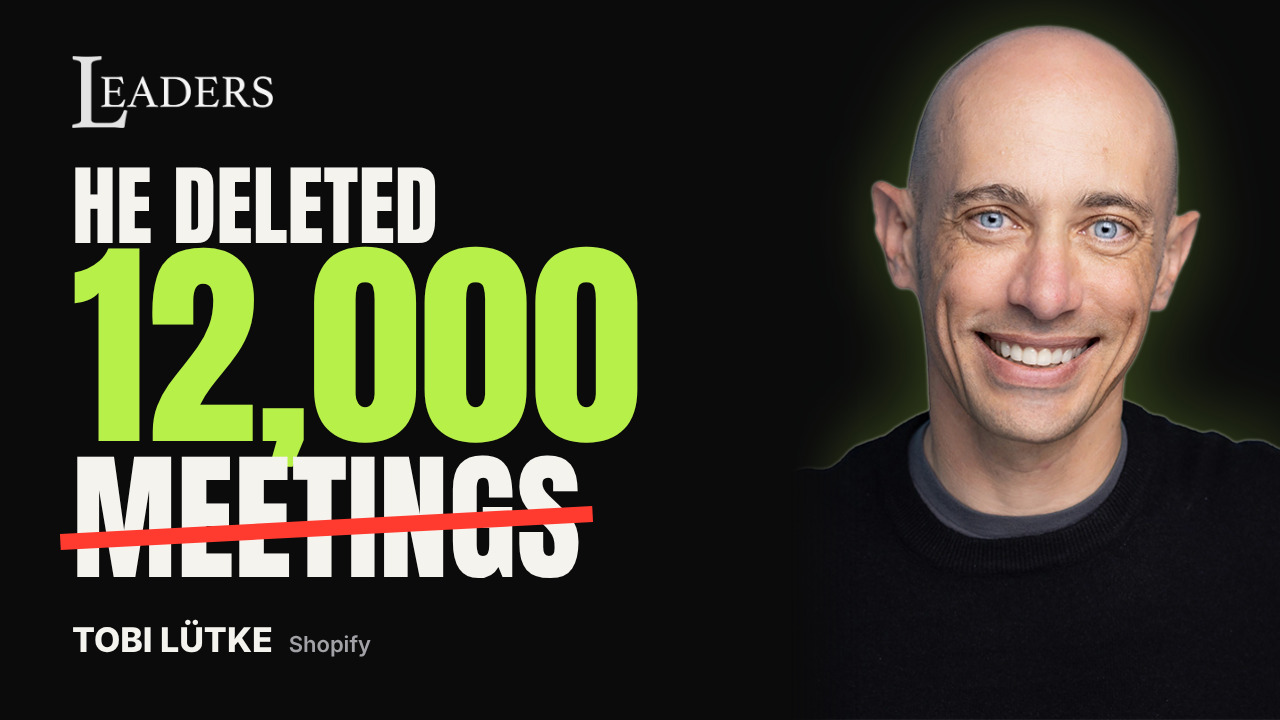
The CEO Who Didn't Believe in Leadership: 7 Lessons From Tobi Lütke's Leadership Style
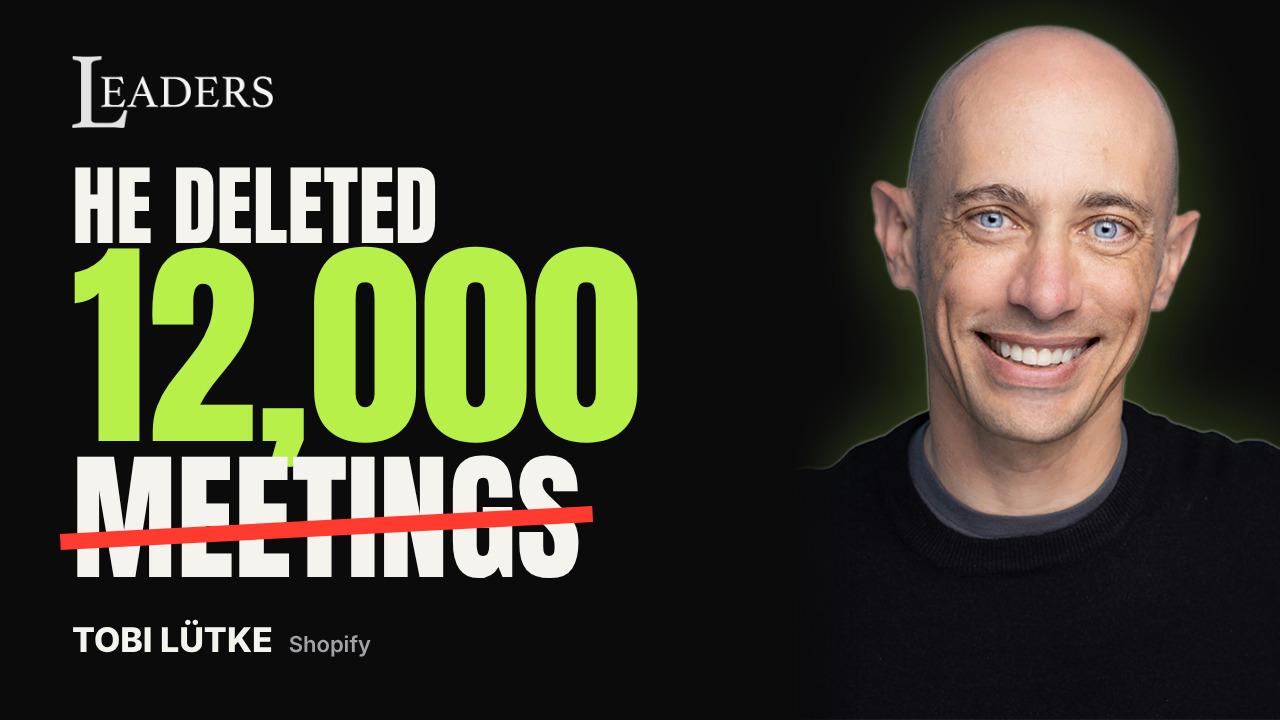
"Shopify, like any other for-profit company, is not a family."
That's how Tobi Lütke opened one section of a memo he sent to the leaders of his company. He didn't soften it. He called the family idea "preposterous" and moved on.
Here's the twist. The man who wrote that memo once didn't believe leadership mattered at all.
Early on, Tobi thought the job was simple: hire good people, point them in a direction, and the right outcomes would follow. He has since said, publicly, that he was wrong. How often does a sitting CEO admit that the thing he's paid to do is real, and that he used to dismiss it?
I spent an episode of Leaders digging into how he leads now. What I found isn't a tidy philosophy. It's three tensions that seem to contradict each other, and they're more useful because of it:
- Patient trust vs. ruthless speed.
- A hard-edged team vs. a belief in unlimited human potential.
- Hundred-year thinking vs. memos that change how thousands of people work in a single week.
Let's take them one at a time. At the end of each, I'll give you something you can actually use on Monday morning.
Tension 1: The trust battery vs. the "Tobi tornado"
Most companies treat trust as something you get with a title. Become a director and people assume you know what you're doing.
Tobi doesn't buy that. He thinks of trust as a battery.
A new colleague starts at about 50%. Every interaction charges it or drains it. Ship what you promised, and it goes up a little. Miss a deadline without warning, and it drops, often a lot. It's slow to fill and fast to empty.
What I love about this is that it takes something "soft" and makes it something a team can talk about. Telling someone "I don't trust you" is a personal attack. Saying "my battery with you is low on this project, and here's why" is a conversation. Shopify found it made trust easier to raise in reviews without anyone feeling ambushed.
Now for the other side of him.
The same patient, relational leader is also known for what's been called the "Tobi tornado." When a project isn't working, he kills it. Fast. No long goodbye, no six-month wind-down to protect anyone's feelings.
He pairs this with a clear rule on decisions: they're collaborative, but not democratic. Everyone gets heard. Not everyone gets a vote.
So which is it, patient or ruthless? Both! The battery governs how he treats people. The tornado governs how he treats projects. Keeping those two separate is the whole trick.
Put it to work:
- Run a trust battery check-in. In your next one-on-one, ask: "Where's your battery with me right now, and what would charge it?" Then answer the same question about them, honestly.
- Write kill criteria before you start. For every new project, agree up front on what result, by what date, would mean you stop. Killing a project gets much easier when the bar was set before anyone got attached.
- Say how a decision will be made before you make it. Tell the room, "I want everyone's input, and then I'm going to decide." People handle a call they disagree with far better than one they thought they'd get to vote on.
Tension 2: A team, not a family
During the pandemic, Tobi sent the memo I quoted at the top. It's long. It's blunt. And it's one of the clearest statements of what a company is that I've read.
His argument against the family idea is practical. You're born into a family. You never chose it, and they can't un-family you. Once people start thinking of their workplace that way, it becomes incredibly hard to let a poor performer go. So he drew the line: Shopify is a team. Like a competitive sports team, what matters is how you show up every day.
He went further. Shopify isn't the government either. It can't solve every social problem or meet every personal need. It exists to build a world-class product for its merchants, and every employee should be able to explain how their job connects to that, step by step.
To be fair, the memo landed hard. It arrived during real internal tension over how the company was handling racial and social justice issues, and plenty of people disagreed with it. Some probably left. I suspect Tobi was fine with that. The people who stayed knew exactly what they'd signed up for.
Here's what makes it more than a tough-guy memo, though.
The Red Queen race
Tobi borrows an idea from Alice in Wonderland: you have to keep running just to stay in place. Shopify had historically grown 40% or more a year. His conclusion? Everyone has to get at least 40% better every year just to re-qualify for the job they already have. That includes him.
That sounds brutal. But read it again. It's actually a bet that people can grow enormously. He even said the strongest predictor of who does well at Shopify is whether they see opportunity as something to fight over, or as something that's basically unlimited. The zero-sum people struggle. The abundance people thrive.
And the hard edge has limits. The memo makes room for people in truly hard situations, like someone who suddenly becomes a primary caregiver or is dealing with mental health struggles. It offers second chances, especially to past top performers. What it won't tolerate is poor performance combined with divisiveness: endless Slack trolling, us-versus-them thinking, a victim mindset.
Don't water it down
My favorite line comes near the end. Tobi anticipates exactly what middle managers do with a tough message: soften it, rephrase it, and pass along a watered-down version. He tells them not to. Their job is to reinforce the message as written and hold their teams to it.
That's a small instruction with a big lesson. Every layer of management sands down a message a little. By the time it reaches the front line, it often means nothing at all.
Put it to work:
- Write down what your team is not. Not a family? Not a support desk for every other department? Naming the boundaries clarifies the mission faster than another vision statement.
- Set your own re-qualification bar. Look at how fast your team or company is growing. Ask yourself, and your direct reports, what being that much better a year from now would actually look like. Write it down.
- Separate hard situations from hard behavior. Decide in advance where you'll show grace (life events, health, a first stumble from a strong performer) and where you won't (persistent divisiveness). Then be consistent.
- Send important messages whole. When something really matters, write it yourself, send it as widely as needed, and tell your managers explicitly not to paraphrase it.
Tension 3: Hundred-year thinking vs. overnight change
Tobi thinks in very long time frames. He reasons backward from a 100-year vision of what Shopify should be.
The media loves to pit Shopify against Amazon. Fewer people notice how alike the two CEOs are here. Both have told shareholders, again and again, that they'll give up short-term revenue for long-term value.
Tobi boils it down to a single question he says almost every business decision turns on:
Are you optimizing for this one transaction, or for the lifetime of the customer?
Put another way: are you playing a finite game with your customers, or an infinite one? It's a great filter for pricing, support policies, upsells, almost anything.
So you'd expect a patient, slow-moving leader. Then came April 2025.
The AI memo
Tobi published an internal memo with a blunt headline: using AI reflexively is now a baseline expectation at Shopify. Not encouraged. Expected.
He'd been nudging people to experiment with AI for a while. His own admission was that it had been "too much of a suggestion." So he made it a requirement, with teeth:
- Using AI well is part of everyone's job. He was honest that opting out wasn't really an option: "Stagnation is almost certain, and stagnation is slow motion failure."
- Prototypes start with AI. The early, exploratory phase of any project should be dominated by AI, because it gets you to something people can react to in a fraction of the time.
- AI shows up in performance reviews. Questions about AI use went into both performance and peer reviews. His reasoning: prompting and giving AI the right context is a real skill, and many people quit after one disappointing try.
- Learn on your own, but share what works. Shopify gave people access to the tools and expected them to swap wins and losses openly.
- Prove AI can't do it before asking for headcount. Before a team requests more people, it has to show why AI can't get the job done. He framed it as a fun question: what would this area look like if AI agents were already on the team?
- Everyone means everyone. Including Tobi and his executive team.
Notice what connects this to the long-term thinking. The AI memo isn't a break from his hundred-year view. It is the hundred-year view, acted on quickly. If the tools are changing how work gets done this fast, waiting is the risky move.
And here's the part I find most interesting. The AI angle isn't really the story. The format is. A CEO writing an open, specific, no-hedging memo about expectations became something other leaders copied. Box, Fiverr and others followed with versions of their own.
Put it to work:
- Add the lifetime question to your decision templates. Before any pricing change or policy decision, write one line answering: does this help the next transaction, or the next ten years with this customer?
- Adopt the headcount test. Before your team requests another hire, have it write a short note on what AI tools already tried and where they fell short.
- Make the expectation explicit, and include yourself. If a new skill really matters, say so in writing, put it in reviews, and hold yourself to the same bar first.
The operating system underneath
Two mental models tie all of this together.
The first is Crocker's rules. The idea comes from online communities: you tell people they can be completely blunt with you, skip the diplomatic padding, and you take full responsibility for how you react. If you're offended, that's on you. Picture a company where feedback is that direct and nobody wastes time cushioning it. That's the culture the memos are pushing toward.
The second is systems thinking. Tobi started as a programmer, and you can see it everywhere. Trust becomes a battery with inputs and outputs. Growth becomes a re-qualification bar. Hiring becomes a question of whether software can do the work first. He takes fuzzy things and turns them into systems you can reason about.
Your Tobi Lütke playbook
If you take nothing else from this, take these seven moves:
- Ask "where's your trust battery with me?" in your next one-on-one.
- Set kill criteria for every new project before it starts.
- Tell people how a decision will be made before you make it: collaborative, not democratic.
- Write down what your team is not.
- Define what "re-qualifying" for your role looks like a year from now.
- Run every big decision through the lifetime question: this transaction, or this customer for the next decade?
- When a message matters, write it yourself, send it whole, and ask managers not to soften it.
The real lesson
The most striking thing about Tobi isn't any single memo. It's that he changed his mind about the very thing he's paid to do, said so in public, and then committed to it harder than most people who believed in it all along.
You don't have to agree with every line he's written. I don't. The family comments in particular will rub plenty of leaders the wrong way. But I'd love to work somewhere where the CEO says exactly what he means, puts it in writing, and holds himself to the same standard he sets for everyone else.
That kind of clarity is rare. It's also free. Any leader can start practicing it this week.

Boring Excellence: 5 Leadership Lessons From Delta CEO Ed Bastian